
Call for papers
Call for Papers – ECONOMICUS 25 issue 2
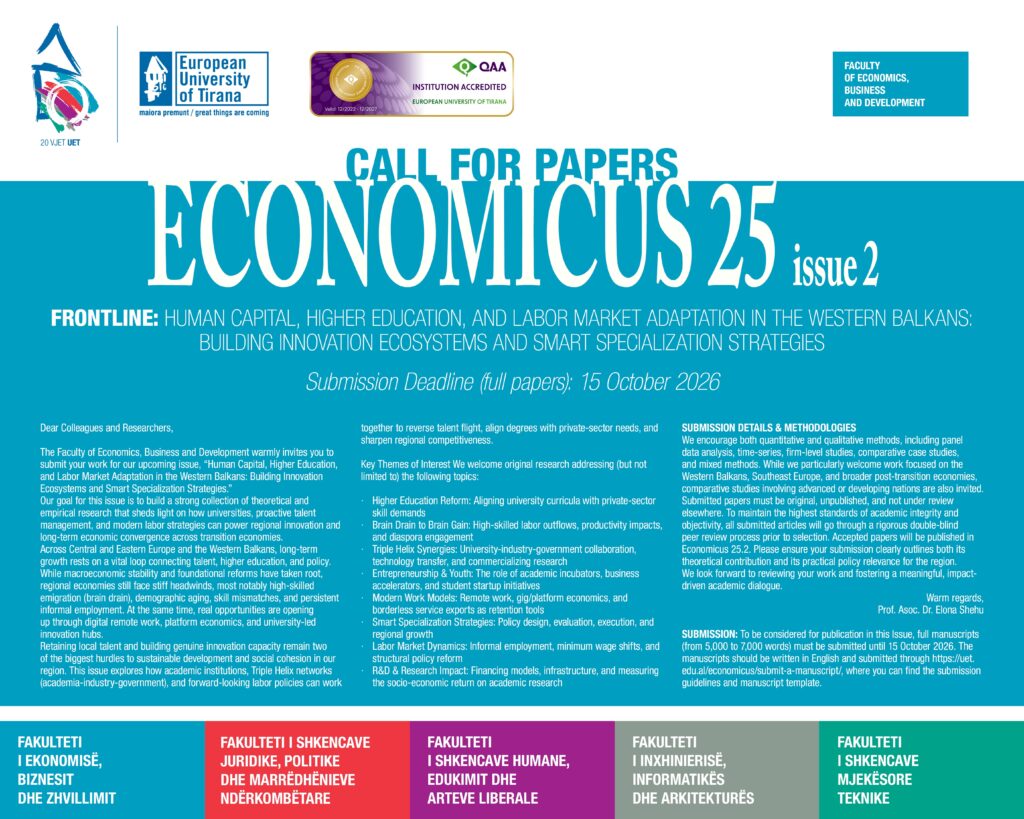
Human Capital, Higher Education, and Labor Market Adaptation in the Western Balkans: Building Innovation Ecosystems and Smart Specialization Strategies
Submission Deadline (full papers): 15 October 2026
Dear Colleagues and Researchers,
The Faculty of Economics, Business and Development warmly invites you to submit your work for our upcoming issue, “Human Capital, Higher Education, and Labor Market Adaptation in the Western Balkans: Building Innovation Ecosystems and Smart Specialization Strategies.”
Our goal for this issue is to build a strong collection of theoretical and empirical research that sheds light on how universities, proactive talent management, and modern labor strategies can power regional innovation and long-term economic convergence across transition economies.
Across Central and Eastern Europe and the Western Balkans, long-term growth rests on a vital loop connecting talent, higher education, and policy. While macroeconomic stability and foundational reforms have taken root, regional economies still face stiff headwinds, most notably high-skilled emigration (brain drain), demographic aging, skill mismatches, and persistent informal employment. At the same time, real opportunities are opening up through digital remote work, platform economics, and university-led innovation hubs.
Retaining local talent and building genuine innovation capacity remain two of the biggest hurdles to sustainable development and social cohesion in our region. This issue explores how academic institutions, Triple Helix networks (academia-industry-government), and forward-looking labor policies can work together to reverse talent flight, align degrees with private-sector needs, and sharpen regional competitiveness.
Key Themes of Interest We welcome original research addressing (but not limited to) the following topics:
- Higher Education Reform: Aligning university curricula with private-sector skill demands
- Brain Drain to Brain Gain: High-skilled labor outflows, productivity impacts, and diaspora engagement
- Triple Helix Synergies: University-industry-government collaboration, technology transfer, and commercializing research
- Entrepreneurship & Youth: The role of academic incubators, business accelerators, and student startup initiatives
- Modern Work Models: Remote work, gig/platform economics, and borderless service exports as retention tools
- Smart Specialization Strategies: Policy design, evaluation, execution, and regional growth
- Labor Market Dynamics: Informal employment, minimum wage shifts, and structural policy reform
- R&D & Research Impact: Financing models, infrastructure, and measuring the socio-economic return on academic research
Submission Details & Methodologies
We encourage both quantitative and qualitative methods, including panel data analysis, time-series, firm-level studies, comparative case studies, and mixed methods. While we particularly welcome work focused on the Western Balkans, Southeast Europe, and broader post-transition economies, comparative studies involving advanced or developing nations are also invited.
Submitted papers must be original, unpublished, and not under review elsewhere. To maintain the highest standards of academic integrity and objectivity, all submitted articles will go through a rigorous double-blind peer review process prior to selection. Accepted papers will be published in Economicus 25.2. Please ensure your submission clearly outlines both its theoretical contribution and its practical policy relevance for the region.
We look forward to reviewing your work and fostering a meaningful, impact-driven academic dialogue.
Warm regards,
Prof. Asoc. Dr. Elona Shehu
Submission: To be considered for publication in this Issue, full manuscripts (from 5,000 to 7,000 words) must be submitted until 15 October 2026. The manuscripts should be written in English and submitted through https://uet.edu.al/economicus/submit-a-manuscript/, where you can find the submission guidelines and manuscript template.
Call for Papers – ECONOMICUS 25 issue 1

Productivity-Led Growth and Economic Convergence in a Post-Transition Economy
Submission Deadline (full papers): 30 March 2026
Dear Colleagues and Researchers!
The faculty of Economics, Business and Management is pleased to invite submissions for our upcoming journal issue focused on “Productivity-Led Growth and Economic Convergence in a Post-Transition Economy.” This call aims to bring together high-quality theoretical and empirical research that advances understanding of the role of productivity in shaping long-term economic growth and convergence processes in post-transition and emerging economies.
More than three decades after the beginning of economic transition, many post-socialist economies continue to face persistent productivity gaps, structural rigidities, and uneven convergence with advanced economies. While macroeconomic stability and market liberalization have largely been achieved, productivity growth remains the key constraint for sustainable development, income convergence, and social cohesion. This Call for Papers seeks to explore how productivity dynamics interact with institutional reforms, technological change, labor markets, and integration into global value chains in post-transition contexts.
We welcome original research papers that address, but are not limited to, the following themes:
• Productivity growth, total factor productivity, and structural transformation
• Economic convergence and divergence patterns in post-transition economies
• The role of human capital, education, and skills in productivity enhancement
• Innovation, digitalization, and technology diffusion
• Firm-level productivity, reallocation effects, and competitiveness
• Labor market dynamics, informality, and employment-productivity linkages
• The impact of institutions, governance, and economic reforms on productivity
• Trade openness, foreign direct investment, and global value chains
• Regional disparities and spatial dimensions of productivity growth
• Policy frameworks for productivity-led and inclusive growth
Both quantitative and qualitative approaches are encouraged, including panel data analysis, time-series methods, firm-level studies, comparative case studies, and mixed-methods research. Submissions focusing on Southeast Europe, the Western Balkans, Central and Eastern Europe, and other post-transition economies are particularly welcome, though comparative perspectives involving advanced or developing economies are also encouraged.
Submitted papers should be original, unpublished, and not under consideration elsewhere. All submissions will undergo a peer-review process to ensure academic rigor and relevance. Selected papers may be considered for inclusion in “Economicus 25.1” Journal.
Authors are encouraged to clearly state the contribution of their research to the literature on productivity, growth, and convergence, as well as its policy relevance.
We believe that this Call for Papers will contribute to an informed academic and policy debate on how post-transition economies can move toward sustainable, productivity-driven growth paths and achieve meaningful economic convergence in a rapidly changing global environment.
We look forward to receiving your submissions and to engaging in a stimulating scholarly exchange.
Sincerely,
Prof. Assoc. Mateo Spaho
Submission: To be considered for publication in this Issue, full manuscripts (from 7000 to 10,000 words) must be submitted until 30 March 2026. The manuscripts should be written in English and submitted through https://uet.edu.al/economicus/submit-a-manuscript/, where you can find the submission guidelines and manuscript template.
Call for Papers – ECONOMICUS 24 issue 2
Global Inequality and the Inclusive Economy
Submission Deadline (full papers): 24 October 2025
The faculty of Economics, Business and Management is pleased to invite submissions for our upcoming journal issue focused on “Global Inequality and the Inclusive Economy”.
Global inequality remains one of the most pressing challenges of the 21st century, manifesting in uneven access to wealth, opportunities, and resources across nations and within societies. While globalization and technological advancement have stimulated economic growth, they have also deepened disparities in income, education, health, and access to markets. The concept of an inclusive economy has therefore emerged as a critical framework for promoting equitable development.
Inequality operates both across and within nations. High-income countries maintain disproportionate access to capital, technology, and global markets, while many low-income countries remain trapped in cycles of debt and underdevelopment. Within societies, divides in income, wealth, and employment opportunities are reinforced by structural barriers such as gender discrimination, unequal education, and weak labor protections.
An inclusive economy emphasizes fairness, accessibility, and sustainability. It prioritizes not only efficiency but also equity and environmental responsibility. At its core is the belief that all individuals should be able to participate in, and benefit from, economic activity. This involves reducing barriers to employment, expanding education and healthcare, and designing financial systems that address the needs of vulnerable groups. Inclusion is both a moral imperative and an economic necessity, since broad participation strengthens productivity and resilience.
Several strategies support inclusive economic systems. Inclusive finance enables access to credit, savings, and insurance for marginalized communities. Investments in education and vocational training reduce skill gaps and expand labor opportunities. Social protection programs, such as universal healthcare or cash transfers, mitigate vulnerabilities and reduce poverty. Finally, sustainable business practices that integrate social and environmental concerns help deliver more equitable outcomes.
Technological change can either exacerbate or reduce inequality. Yet digital innovations also expand access to mobile banking, online education, and telemedicine, particularly in underserved areas. Realizing the inclusive potential of technology requires policies that bridge digital divides, ensure affordable connectivity, and foster digital literacy.
The Sustainable Development Goals (SDGs) provide a global framework for reducing inequality and building inclusive economies. SDG 1 (No Poverty), SDG 5 (Gender Equality), SDG 8 (Decent Work and Economic Growth), and SDG 10 (Reduced Inequalities) directly address disparities. Meanwhile, SDG 4 (Quality Education) and SDG 9 (Industry, Innovation, and Infrastructure) strengthen the enabling conditions for inclusive participation. By embedding inclusivity across all 17 goals, the SDGs recognize that reducing inequality is inseparable from achieving sustainability, resilience, and global justice.
Progress depends heavily on policy choices and international cooperation. Governments must promote fair taxation, regulate labor markets, and invest in infrastructure and healthcare. Globally, stronger governance of trade, migration, and climate change ensures that globalization delivers shared benefits. The SDGs serve as a unifying agenda, aligning national strategies with international commitments.
Global inequality threatens economic stability and social cohesion. The inclusive economy offers a path forward by aligning growth with equity, sustainability, and human dignity. Guided by the SDGs, achieving inclusivity requires coordinated action across finance, technology, education, and governance. While challenges remain, an inclusive economy represents not only an aspiration but a practical roadmap for a more just and resilient global order.
We invite theoretical, empirical, and policy-oriented papers that address, but are not limited to, the following topics:
1. Microfinance: successes, failures, and evolving models
2. Mobile money and digital banking inclusion in emerging markets
3. Gender and finance: barriers and opportunities
4. The impact of remittances on household and national development
5. The Sustainable Development Goals (SDGs) as a global framework for reducing inequality and building inclusive economies
6. Financial literacy and behavioral interventions for inclusion
7. The role of public policy in reducing financial inequality
Submission: To be considered for publication in this Issue, full manuscripts (max. 10,000 words) must be submitted by 24 October 2025. The manuscripts should be written in English and submitted through https://uet.edu.al/economicus/submit-a-manuscript/, where you can find the submission guidelines and manuscript template.
Call for Papers – ECONOMICUS 24 issue 1
Sustainability and Green Practices in Business
Submission deadline (full papers): 3 May 2025
The faculty of Economics, Business and Management is pleased to invite submissions for our upcoming journal issue focused on “Sustainability and Green Practices in Business”.
In today’s rapidly evolving global economy, the integration of sustainable and green practices in business operations has become not only a moral imperative but also a strategic necessity. While many companies recognize the importance of sustainability for long-term success, they continue to face a range of complex challenges when attempting to implement environmentally responsible practices.
One of the primary challenges is the cost of transition. Shifting from traditional models to sustainable alternatives often requires significant upfront investment in green technologies, renewable energy, sustainable sourcing, and eco-friendly infrastructure. For small and medium-sized enterprises (SMEs), these costs can be particularly burdensome and may hinder their ability to compete. Another major challenge is the lack of clear and consistent regulatory frameworks. While there is increasing pressure from governments and international bodies to adopt greener practices, many businesses operate in regions where environmental regulations are inconsistent or poorly enforced. This uncertainty makes long-term planning and investment in sustainability initiatives more difficult.
Supply chain sustainability also poses a significant hurdle. Businesses are expected to ensure that their entire supply chains — from raw material extraction to product delivery — adhere to environmental and social standards. However, tracking and verifying sustainability across complex, global supply chains is both technically and logistically challenging.
Moreover, companies face increasing demands from consumers and stakeholders for transparency and accountability. Environmental, Social, and Governance (ESG) reporting has become a key component of business strategy, but many organizations struggle with collecting reliable data and reporting it in a meaningful way. Greenwashing — the practice of conveying a false impression of environmental responsibility — has also become a growing concern, damaging trust and credibility.
Finally, cultural and organizational change within companies can be slow. Embedding sustainability into a company’s core values and day-to-day decision-making requires a shift in mindset at all levels of the organization, from leadership to frontline employees.
Despite these challenges, businesses that successfully implement sustainable and green practices can achieve significant benefits, including improved brand reputation, increased operational efficiency, and long-term profitability. Addressing these issues requires collaboration between governments, industries, and consumers, as well as innovative thinking and a strong commitment to environmental stewardship.
We invite theoretical, empirical, and policy-oriented papers that address, but are not limited to, the following topics:
Sustainability and Green Practices in Business.
• Sustainable supply chain management
• Sustainable business models and their impact on the circular economy
• ESG (Environmental, Social, Governance) and impact reporting
• Redesign logistics and operations to reduce emissions, such as by optimizing transportation routes, switching to greener energy sources, or reducing packaging waste.
• Cultural and organizational change within companies. Old behaviours and new models
• Fiscal incentives in sustainable business
• Environmental awareness and education, at the leadership level and among consumers. Additional cost or a strategic investment?
• How to reach a sustainable economic model through a close cooperation between the private sector, the government, and civil society.
• Innovation and sustainable development: How can they be connected and remain competitive compared with existing technologies?
• The connection between employment and new sustainable practices in production and transportation.
Submission: To be considered for publication in this Issue, full manuscripts (max. 10,000 words) must be submitted by 3 May 2025. The manuscripts should be written in English and submitted through https://uet.edu.al/economicus/submit-a-manuscript/, where you can find the submission guidelines and manuscript template.
Call for Papers – ECONOMICUS 23 issue 2

Macroeconomic Policy Management in the context of EU integration
Submission deadline (full papers): 15 October 2024
The faculty of Economics, Business and Management is pleased to invite submissions for our upcoming journal issue focused on “Macroeconomic Policy Management in the Context of EU Integration.” The issue of Macroeconomic Policy Management in the Context of EU Integration revolves around the challenges and opportunities that European Union (EU) member states and candidate countries face as they align their economic policies within the broader framework of EU integration. This process involves coordinating fiscal and monetary policies to ensure stability and growth while adhering to EU rules and regulations.
Key challenges include achieving economic convergence among diverse economies, managing the implications of EU fiscal rules on national budgets, and responding to economic crises within a unified economic area. The European Central Bank plays a crucial role in guiding monetary policy across the Eurozone, but the varying economic conditions across member states make this task complex.
By examining both theoretical perspectives and empirical case studies, this call for papers aims to contribute to the development of effective macroeconomic strategies that align with the goals of EU integration while addressing the unique circumstances of individual countries. Ultimately, the objective is to foster a deeper dialogue on the future of macroeconomic policy within the EU and to identify pathways for more robust and resilient economic governance in an increasingly interconnected European landscape. We invite theoretical, empirical, and policy-oriented papers that address, but are not limited to, the following topics:
The impact of EU integration on fiscal and monetary policy coordination.
- Challenges of macroeconomic stability in the context of EU enlargement.
- The role of the European Central Bank in managing monetary policies across diverse economies. Structural reforms and their macroeconomic implications within the EU framework. The convergence of macroeconomic indicators among EU member states. The influence of EU fiscal rules on national budgetary policies.
- Economic governance in the EU: successes, failures, and lessons learned.
- Policy responses to economic crises in the context of EU integration.
- Trade policies and their macroeconomic effects in the EU.
- The future of macroeconomic policy in an evolving European Union.
Submission: To be considered for publication in this Issue, full manuscripts (max. 10,000 words) must be submitted by 15 October 2024. The manuscripts should be written in English and submitted through https://uet.edu.al/economicus/submit-a-manuscript/, where you can find the submission guidelines and manuscript template.